How to Get Back in a Kayak After a Capsize: Deep-Water Reentry, Step by Step
Quick Answer: Deep-water reentry has one universal sequence: stay with the boat, control your paddle, flip the hull upright, then climb aboard belly-first at the boat’s most stable point - behind the seat area, kicking your legs to horizontal so you slide on like a seal rather than pulling down like a ladder climber. Sit-on-tops are dramatically easier and most beginners can learn reentry in twenty minutes; sit-inside kayaks add a flooded cockpit to manage and reward a paddle float and bilge pump. The real lesson: this skill exists only if practiced - deliberately, in warm shallow water with a friend - because the first attempt should never be the real one. Late August’s warm lakes are the season’s last easy classroom.
Every kayaker capsizes eventually - a wake, a lean, a moment of ambition photography - and the entire difference between a funny story and a genuine emergency is whether you can get back in the boat without touching shore. It is a twenty-minute skill. Almost nobody practices it. Be almost nobody’s exception.

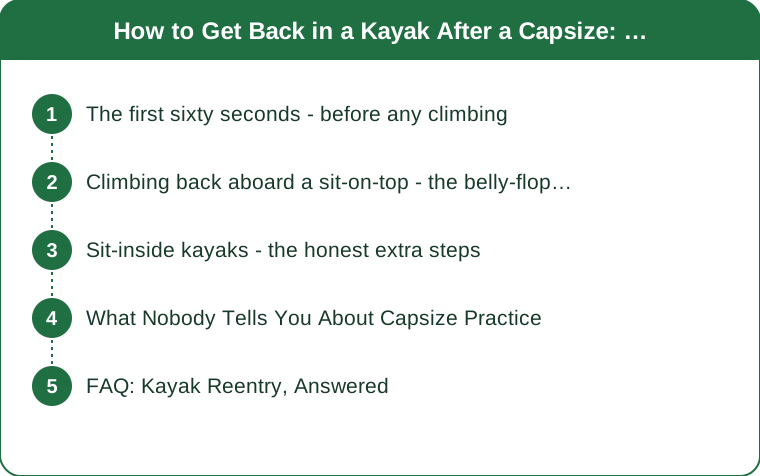
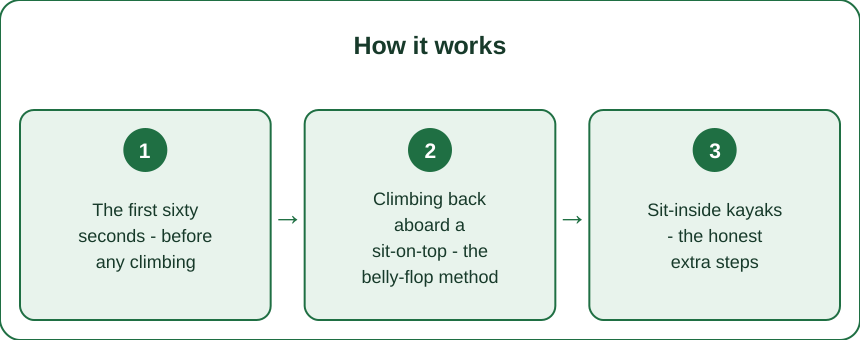
The first sixty seconds - before any climbing
What you do immediately after splashing matters more than technique.
Stay with the boat - it is the whole strategy. A kayak floats, carries your supplies, is visible to rescuers at distances a swimmer’s head is not, and is your ride home. Swimming for shore while the boat drifts is the classic compounding error: distances over water read deceptively short, and cold or current turns them long. The boat is the plan; the shore is the backup.
Get eyes on the boat and hands on something. Surface, breathe, and take one deliberate orientation beat - wind and waves move a capsized kayak faster than most people expect, and the gap between you and the hull opens in seconds. One hand on the boat (grab handle, perimeter line, anything) ends the chase before it starts.
Manage the paddle without losing the boat. The paddle is your engine and your second flotation opinion; slide it under a deck line, clip the leash if you run one, or grip it together with the handle in one fist. Never release the boat to chase the paddle - a boat downwind of you outruns your swimming; a paddle mostly does not.
Then flip the hull. Reach across the overturned hull to the far side - grab the far edge or handle, brace your knees or feet against the near side, and pull toward yourself while pushing down with your legs; the boat rolls upright over your effort. Small kayaks flip back with modest force; wide fishing hulls take real commitment and sometimes a second try with better leverage. Expect a sit-inside to come up carrying water - that is normal, and the pump deals with it after you are aboard, not before.
One more habit that makes all of this work: dress and rig for the swim you might take. A properly fitted life vest worn always (it is doing the floating while you do the thinking), nothing loose in the cockpit that was not tethered, and clothing that swims - quick-dry layers and leggings climb back aboard light, while cotton and denim climb back aboard heavy and cold.
Climbing back aboard a sit-on-top - the belly-flop method
Sit-on-tops are the forgiving classroom, and the method is almost universal.
Position at the boat’s waist. Move to the side of the kayak roughly at or just behind the seat - the widest, most stable zone. Avoid the bow and stern: narrow ends dip and roll under load, and the climb becomes a rodeo. Face the boat, both hands on the near side of the deck (grab handle plus deck fitting, or two solid grips a shoulder-width apart).
Kick to horizontal before you pull. This is the entire trick. Let your legs float up behind you until your body lies flat at the surface like a swimmer - then kick hard and pull-push in one motion, driving your chest and belly across the seat area. Pulling straight down from a vertical body position - the instinctive ladder-climb - drags the rail toward your weight and either flips the boat onto you or exhausts you against physics. Horizontal bodies slide aboard; vertical bodies capsize boats. If the first attempt fails, reset floating and kick harder - the second horizontal attempt succeeds far more often than the fifth vertical one.
Arrive belly-down, stay low. You should land draped across the kayak on your stomach, head over the far edge, legs still in the water - graceless and correct. Pause there; the boat is stable with your weight low and centered.
Rotate, then sit. Keeping your center low, swing one leg over into a straddle (facing the bow or stern, either works), then pivot your hips into the seat and bring your legs aboard one at a time. Every movement stays slow and low - the climb fails at the end for people who sit up tall while still sideways.
Retrieve, breathe, resume. Paddle back in hand, feet in their braces, one minute of just breathing before you paddle on. Adrenaline spends energy you will want later; the pause is part of the skill.

Sit-inside kayaks - the honest extra steps
The same physics with two complications: a cockpit that floods and a rail that sits lower.
Expect the water and carry the pump. A capsized sit-inside comes upright with a cockpit full of water - stable enough to enter in calm conditions, but heavy and sluggish. The tools that turn this from ordeal to routine cost little: a bilge pump clipped where you can reach it from the water, and a paddle float (an inflatable sleeve for one paddle blade) that converts your paddle into an outrigger.
The paddle-float reentry, condensed: inflate the float onto one blade; lay the paddle across the deck just behind the cockpit, float-side out on the water, and grip paddle shaft and cockpit rim together with one hand - the paddle is now a stabilizing outrigger. Kick horizontal, belly across the rear deck with your weight partly on the shaft, then bring one foot, then the other, onto the shaft or into the cockpit, staying face-down and low. Rotate belly-down around toward the bow, drop your seat into the cockpit last, and keep a hand on the braced paddle throughout. Then pump the cockpit dry - which takes longer than you think and is why the pump lives on a clip, not in a hatch.
The cowboy scramble is the no-gear alternative: straddle the rear deck from behind the cockpit like mounting a horse, scoot forward low along the deck, and drop in - quick when it works, balance-dependent, and worth learning as the backup on a calm day.
Know the honest limits. Reentry in wind, waves, or cold gets harder exactly when it matters most; a flooded boat in chop may need repeated pumping; and some conditions defeat solo reentry entirely - which is why paddling with company, staying near shorelines you could actually swim, filing a float plan, and carrying communication (phone in a waterproof pouch on your body, not the boat) are not paranoia but the sport’s basic arithmetic. Cold water changes everything faster than any skill compensates: swim failure comes in minutes, not the hour people imagine.
General information, not a substitute for hands-on instruction - a half-day rescue class with a certified instructor is the single best money in paddling.
What Nobody Tells You About Capsize Practice
The skill has an expiration date without rehearsal. Reading this article creates the illusion of the skill; only wet practice creates the skill. The prescription: one deliberate practice session now - warm water, chest-deep to start, a friend standing by, life vest on - flipping and reentering five times per method until boring. Late August is the gift window: the water is at its warmest, the swim is pleasant, and the version of you paddling a cool October lake will be borrowing today’s rehearsed reflexes.
Fatigue arrives shockingly fast in real capsizes. Adrenaline, clothing drag, and a minute of unproductive vertical pulling can spend most of a casual paddler’s climbing strength - which is why the horizontal-body technique matters so much (it is cheap) and why the first attempt should be your best-form attempt, not your panic attempt. In practice sessions, do one reentry after treading water for two minutes; that rehearsal honesty is worth ten easy ones.
Your boat has a personality - meet it in advance. Wide fishing sit-on-tops flip upright grudgingly but climb like docks; narrow touring hulls flip easily and climb twitchy; inflatables barely notice you boarding. Load matters too: a kayak with a cooler and rod holders capsizes into a yard sale unless everything was leashed - the pre-launch tether check is a reentry skill wearing a packing costume.
Glasses, hats, and phones are the most common casualties. Croakies on the sunglasses, leash on the hat brim if you love it, phone in a floating waterproof pouch worn on the vest. The capsize itself is free; the unsecured accessories are where it gets expensive.
Practice the flip itself, not just the climb. Deliberately capsizing - leaning until you go over, in controlled conditions - removes the startle from the real event and teaches you where your body, paddle, and boat end up. People who have flipped on purpose respond to accidental flips like a drill; people who have not respond like a surprise party in cold water.
And tell someone the plan, every time. The float plan - where, with whom, back by when - is the rescue system that works even when the reentry does not. It costs one text message and has closed more bad loops than any technique in this article.
FAQ: Kayak Reentry, Answered
How do I get back on a sit-on-top kayak in deep water?
Stay with the boat, secure the paddle, flip the hull upright, then position at the seat area, kick your legs up behind you until horizontal, and pull-kick your belly across the deck in one motion. Rotate low into a straddle, then into the seat. The horizontal body position is the entire trick - vertical pulling flips the boat toward you.
Is getting back into a sit-inside kayak harder?
Yes - the cockpit floods on capsize and the reentry benefits from gear: a paddle float to rig your paddle as an outrigger and a bilge pump to empty the boat once aboard. The sequence is the same physics (horizontal body, low and slow) with extra steps, and it genuinely deserves a practice session and ideally a rescue class before you rely on it.
What should I do the moment I capsize?
Surface, breathe, and put a hand on the boat before anything else - wind moves a loose kayak faster than you swim. Then secure the paddle, flip the hull, and reenter. Swimming for shore while your boat drifts away is the classic error; the boat is your flotation, your visibility, and your ride.
How can I practice capsizing safely?
Pick a warm, calm day, chest-deep water over a clean bottom, life vest on, and a friend standing by; deliberately lean over, flip, and run the full sequence - five repetitions per method, then one more after two minutes of treading water for honesty. Twenty to forty minutes converts the skill from theory to reflex, and late summer’s warm water is the ideal classroom.
What gear actually matters for self-rescue?
A properly fitted life vest worn always (non-negotiable - it does the floating while you do the technique), deck lines or handles you can grip, a leash plan for the paddle, and for sit-insides a paddle float and clipped bilge pump. Add quick-dry clothing that swims light, secured glasses and phone, and a float plan text before launch - the unglamorous kit that turns capsizes into stories.
TL;DR:
- Stay with the boat, secure the paddle, flip the hull - the first sixty seconds are strategy, not swimming.
- The universal climb: horizontal body, kick hard, belly across the seat area, rotate low - vertical ladder-pulling flips the boat onto you.
- Sit-on-tops reboard easily; sit-insides flood and reward a paddle float, a clipped pump, and real practice.
- Rehearse deliberately in warm shallow water - five reps per method plus one tired rep - because the first real attempt should never be the first attempt.
- Life vest always, quick-dry clothing, leashed gear, float plan sent; cold water and wind shrink every margin, so practice while August is still warm.
The swim is inevitable if you paddle enough seasons; the emergency is optional. Twenty rehearsed minutes in warm water buys you a lifetime of capsizes that end as stories told at the takeout.
Keep Reading
This article is for general informational and styling purposes only. Fit, sizing, and product availability may vary.