How To Read Wind Forecasts Before You Paddle
Quick Answer: Wind speed alone is a poor predictor of conditions. What matters is the gust value rather than the average, the direction relative to your route and to any current, the fetch, meaning how much open water the wind has crossed to build waves, and whether the wind opposes a tidal flow, which produces disproportionately steep water. As a rough guide, recreational paddlers should think carefully above about 10 to 12 knots sustained and treat 15 knots or gusts above 20 as a strong reason to change plans.
The app says 12. Yesterday it said 12 and the water was glass. Today it is unpleasant within ten minutes.
The number was the same. Four other things were not, and those four are what you should actually be reading.

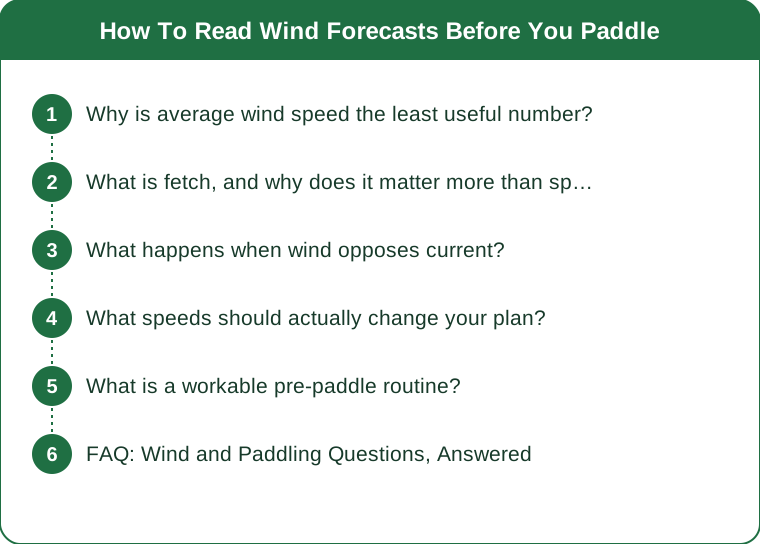
Why is average wind speed the least useful number?
Because you paddle in the gusts, not in the average.
Wind is inherently turbulent. A forecast of 12 knots sustained usually implies gusts substantially higher, often 1.3 to 1.5 times the sustained value, so 15 to 18 knots in practice. Over land with obstacles, gust factors are higher still.
The gust is what matters because it is what catches your blade in the air, pushes your bow off line, and creates the moment of instability. A steady 15 knots is more manageable than a variable 10 gusting 22.
Read the gust value first. Most forecasts publish it separately, and it is a better single predictor of how the day will feel than the sustained figure.
A useful rule of thumb for planning: treat the gust value as your planning number and the sustained value as your paddling number. Plan for the gusts, pace for the average.
Units matter and get confused. Marine forecasts use knots; general weather apps often use mph or kph. One knot is about 1.15 mph. A 15 knot forecast is around 17 mph, so a paddler reading an mph app and applying knot-based guidance will systematically underestimate.
What is fetch, and why does it matter more than speed?
Fetch is the distance of open water the wind has traveled over before it reaches you. It determines how large waves can grow, and it explains why identical wind speeds produce completely different water on different days and different parts of the same lake.
The relationship is not subtle. Ten knots blowing across 500 meters of water produces small ripples. The same ten knots blowing across 15 kilometers produces a genuine chop with whitecaps.
Practical implications:
- Wind direction determines your fetch on any given body of water. On a long narrow lake, wind along the axis produces far worse conditions than wind across it, at identical speed.
- The lee shore is protected; the windward side is not. Launching in the lee can be completely misleading about what you will find once you leave shelter.
- Conditions build over the day. Waves take time to develop, so the same wind produces worse water at 3pm than at 10am. Morning paddles are calmer for reasons beyond thermal wind patterns.
Check the direction against a map before you go. Two minutes looking at where the wind will have come from tells you more than any amount of staring at the speed number.
What happens when wind opposes current?
It produces water that is far worse than the wind speed alone would suggest, and this is the single most underestimated hazard on the list.
When wind blows against a current, whether tidal or river flow, the waves are compressed. They become shorter in wavelength, steeper, and closer together. The technical description is wind-against-tide, and the resulting water can be genuinely difficult in conditions that would be trivial on still water.
A 10 knot wind against a 2 knot tidal flow can produce steeper, more breaking water than a 20 knot wind flowing with the same tide.
Where this catches paddlers:
- Tidal estuaries and inlets, where flow can be strong and directions reverse
- River mouths
- Narrow channels between islands, where flow accelerates
- Any location where a tide table matters
What to do:
- Check a tide table alongside the wind forecast for any tidal water
- Plan to be in exposed areas during slack water where possible
- If wind and tide oppose, consider changing the timing rather than the route
The reverse is also worth knowing. Wind with tide flattens water considerably, so the same location can be easy and difficult on the same day, six hours apart.

What speeds should actually change your plan?
These are rough guides for recreational paddling in a sea kayak or touring boat, and every one of them is modified by fetch, direction, water temperature, and your own experience.
Under 8 knots: generally comfortable for most recreational paddlers on most water.
8 to 12 knots: noticeable. Manageable for competent paddlers, and it will make an upwind leg genuinely hard work. Plan the return leg carefully.
12 to 15 knots: this is where recreational paddling gets demanding. Whitecaps typically appear around 12 to 15 knots. Boat handling becomes a skill question rather than a fitness question.
Above 15 knots, or gusts above 20: a strong reason for recreational paddlers to change plans, choose sheltered water, or stay off. Not an absolute rule, and a good default.
Two modifiers that override all of the above:
Offshore wind is more dangerous than onshore at the same speed, because a failure means being blown away from land rather than toward it. Treat offshore wind considerably more conservatively.
Water temperature changes the entire calculation. In summer, a capsize in 22 degree water is an inconvenience. In autumn, with water dropping through the teens, the same capsize is a serious event. Cold water shock is a real risk below about 15 degrees, and it can incapacitate a strong swimmer within a minute.
This is the specific autumn trap. Air temperature is still pleasant, so paddlers dress for the air. Water temperature has dropped substantially and lags the air by weeks. Dress for the water, not the day, and check the water temperature separately from the forecast.
What is a workable pre-paddle routine?
Five minutes, done in the same order every time.
1. Check gust, not just sustained. Read the higher number and plan around it.
2. Check direction against your route on a map. Which leg is upwind? Where is the fetch longest? Is your return leg the hard one?
3. Plan to paddle out into the wind and back with it. This is the single most useful planning principle in paddling. Go out against it while you are fresh and return with assistance when you are tired. The reverse is how people get into trouble.
4. Check the tide table if the water is tidal, and specifically whether wind and flow oppose during your window.
5. Check water temperature and dress for immersion, not for the air. In autumn especially.
Then set a turnaround rule before you launch. A time, a landmark, or a condition. Something like: if it is gusting over 18 by the time I reach the point, I turn back. Deciding this on shore is far more reliable than deciding it on the water while tired.
A note on forecast sources: general weather apps are optimized for land and tend to under-report wind over water, where there is less friction. Marine or sailing-specific forecasts are meaningfully more accurate for paddling, and several are free. If you paddle regularly, switching sources is the easiest accuracy improvement available.
This is general information, not a substitute for formal paddling instruction or local knowledge. Take a course, paddle with others, and always carry appropriate safety equipment.
FAQ: Wind and Paddling Questions, Answered
What wind speed is too much for kayaking?
As a rough guide, above 15 knots sustained or gusts above 20 is a strong reason for recreational paddlers to change plans. Fetch, direction, and water temperature all shift that threshold in either direction.
Why does the same wind speed feel different on different days?
Fetch and direction. Wind crossing a long stretch of open water builds far larger waves than the same wind crossing a short one, and wind opposing a current produces disproportionately steep water.
Should I paddle out with the wind or against it?
Against it, always, when you have the choice. Go out into the wind while fresh and return with it helping you when you are tired. Doing it the other way is a common cause of paddlers being unable to get back.
TL;DR:
- Read the gust value, not the average. You paddle in the gusts.
- Fetch determines wave size. Check wind direction against a map before you check anything else.
- Wind against current produces steep, breaking water far worse than the wind speed suggests. Check tide tables on tidal water.
- Above 15 knots sustained or gusts over 20 is a strong reason to change plans for recreational paddlers. Offshore wind deserves more caution than onshore.
- In autumn, dress for the water temperature, not the air. The water lags the air by weeks and that gap is where the risk is.
Paddle out against the wind and back with it. If you take one thing from the forecast, take the direction.
Keep Reading
This article is for general informational and styling purposes only. Fit, sizing, and product availability may vary.