Kayak: Buy or Rent? The Honest Guide to Getting on the Water
Quick Answer: Rent until you’ve paddled at least 6–8 times. Buy when three things are true: you’ll paddle 10+ times a year, you have somewhere to store a 10–12 foot boat, and you can actually transport it. At typical rental rates of $25–60 a day, a $500 recreational kayak pays for itself in roughly 10–15 outings — but only if the storage and transport problems are already solved. If either one isn’t, keep renting; that’s not a failure, it’s arithmetic.
Every marina has the same two people. One rented a kayak eleven times this summer and has now spent more than a boat costs. The other bought a kayak in April and it has been leaning against the garage wall since May, quietly becoming a shelf.
The question isn’t really buy or rent. It’s whether the logistics of ownership fit your actual life.

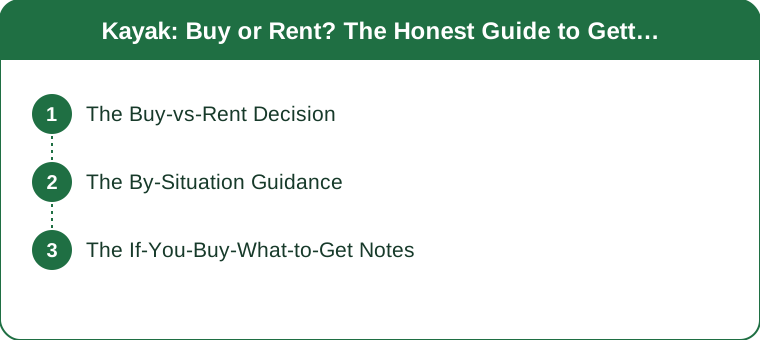
Should I buy a kayak or keep renting?
The decision rests on four honest questions, and only the first is about money.
1. How often will you really paddle? Not aspirationally. Look at last summer: how many weekends did you actually get on the water? Under 6 outings a year, renting wins comfortably. Over 10, buying starts making sense. In between, it depends on the other three questions.
2. Where will it live? A recreational kayak is typically 10–12 feet long and 40–60 lbs. That’s a garage wall, a shed, a side yard with a cover, or ceiling hoists. If your honest answer is “the balcony,” look at inflatables instead — they’re genuinely good now and store in a closet.
3. How will it get to the water? Roof rack and lifting 50 lbs overhead, a trailer, or a truck bed. This is the step that quietly kills more kayak ownership than anything else — plenty of people have a boat they can’t be bothered to load alone.
4. Do you know what you like yet? Sit-on-top vs sit-inside, recreational vs touring, 10 foot vs 14 foot. These paddle very differently, and the way to find out is to rent several.
The break-even math: at $25–60 per day for a rental, a $400–700 recreational kayak pays back in about 10–15 outings. Add the true cost of ownership — paddle, PFD, roof rack ($150–300 if you don’t have one), storage — and realistic break-even is closer to 15–20 outings. Spread over two or three seasons, that’s still an easy win for a regular paddler.

Which is right for your situation?
Rent if you’re new. Six to eight rentals is a genuinely cheap education — and each one is a free test drive of a different hull. You’ll finish knowing whether you’re a sit-on-top person, whether you want length for speed or width for stability, and whether you actually like this enough to store a boat.
Rent if you paddle occasionally, travel to different waters, or live somewhere with a short season. Renting also means no maintenance, no winter storage, and no straps.
Buy if you’ll paddle often — and especially if you want the spontaneous evening paddle, which rental hours make impossible. Ownership’s real dividend isn’t cost per trip; it’s that a boat in the garage turns a nice Tuesday into an outing.
Buy secondhand. The used market is excellent, because a lot of kayaks are bought by people who never answered question 2. End of season (September–October) is the best time — Facebook Marketplace, Craigslist, and outfitters selling off their rental fleet, which is a genuinely smart buy: rental boats are chosen to be durable and beginner-friendly.
Consider sharing. Splitting a boat with a friend or neighbor who paddles on different days halves the cost and the storage burden. So does a club or outfitter season pass, which is often the best value of all if you paddle 8–15 times.
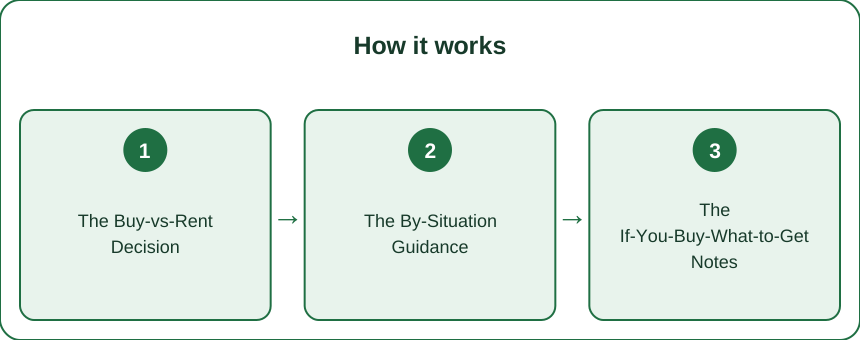
If you buy, what kind of kayak should you get?
Know the two big forks first.
Sit-on-top vs sit-inside. Sit-on-tops are more forgiving, self-draining, easy to climb back onto, and better in warm weather — they’re the beginner-friendly default. Sit-insides keep you drier and warmer, protect from wind, and are better for cool climates and longer paddles.
Recreational vs touring. Recreational kayaks are 9–12 feet, wide, stable and slow — perfect for lakes and calm rivers, which is where most people actually paddle. Touring kayaks are 14–17 feet, faster, track better, handle open water, and are a lot of boat for a first purchase.
Match it to your water. Calm lakes and slow rivers: a stable 10–12 foot recreational kayak. Coastal or big open water: you want a touring boat and instruction to go with it. Buying a boat for water you don’t paddle is how people end up with something they’re slightly afraid of.
Match it to your transport and storage before you fall in love with a hull. A 14-footer you can’t lift is worse than a 10-footer you can.
Budget the whole kit, not just the boat:
| Item | Typical cost |
|---|---|
| Recreational kayak (new) | $400–800 |
| Used kayak | $200–450 |
| Paddle (don’t cheap out) | $80–150 |
| PFD — non-negotiable | $60–120 |
| Roof rack / straps | $50–300 |
| Bilge pump, whistle, dry bag | $50 |
The paddle is the piece people under-budget and most regret — you hold it for the entire trip, and a lighter one changes how far you’ll go.
Always wear the PFD, tell someone your plan, check wind and weather before you go, and take a basic paddling and rescue class if you’re heading anywhere beyond a small calm lake. This is the part of kayaking where the stakes are real.
5 Mistakes Everyone Makes Buying a First Kayak
- Buying before solving storage and transport. The number one cause of garage kayaks. Answer those two questions first, in writing.
- Buying too long, too fast. A 14-foot touring boat is faster and much less forgiving. Most first-timers are better served by 10–12 feet of stability.
- Spending everything on the boat and $40 on the paddle. A heavy paddle makes every trip shorter and worse.
- Skipping the rental phase. Six rentals costs less than the wrong boat, and teaches you what you actually want.
- Forgetting the loading reality. The third mistake is the most common, but this is the sneakiest — if you can’t get the boat on the car by yourself in under five minutes, you will not go alone, and going alone is half the point.
Mini FAQ
How much does it cost to rent a kayak?
Typically $15–30 per hour or $25–60 per day in the US, with multi-day and season passes often available. Guided tours cost more and are worth it once for the instruction. If you’re renting more than about ten days a season, price out a season pass at your local outfitter before you buy a boat — it’s frequently the best-value middle option.
Are inflatable kayaks any good?
Modern drop-stitch inflatables are genuinely capable for calm water, and they solve the storage and transport problems completely — they fit in a closet and a car trunk. The trade-offs are 10–20 minutes of setup, slightly slower paddling, and more wind sensitivity. If you live in an apartment, this is often the only form of ownership that makes sense.
What size kayak should a beginner buy?
10–12 feet, with a beam (width) of 28–32 inches for stability. Shorter turns more easily and is lighter to carry; longer tracks straighter and glides better. If you’re taller or over about 220 lbs, check the capacity rating and lean toward 12 feet — an overloaded kayak sits low and handles poorly.
TL;DR:
- Rent 6–8 times first — it’s the cheapest way to learn what you want.
- Buy only if you’ll paddle 10+ times a year and have storage and transport.
- Break-even is roughly 15–20 outings once you count paddle, PFD and rack.
- Beginner default: stable 10–12 ft recreational sit-on-top, matched to your water.
- Buy used in the fall, including ex-rental fleet boats.
- Don’t cheap out on the paddle; never skip the PFD.
Rent to learn, buy when the logistics genuinely fit — and get on the water either way.
Keep Reading
This article is for general informational and styling purposes only. Fit, sizing, and product availability may vary.