Why Your Shoulders Burn Out Before Your Arms Do When Kayaking
Quick Answer: Shoulder fatigue during kayaking usually comes from paddling primarily with the arms instead of rotating the torso, which forces the relatively smaller shoulder muscles to do work that the larger core and back muscles are better suited for. Adding deliberate torso rotation to each stroke shifts the load and noticeably delays fatigue.
If your shoulders feel cooked halfway through a paddle while your arms feel comparatively fine, technique — not conditioning — is almost always the actual cause.

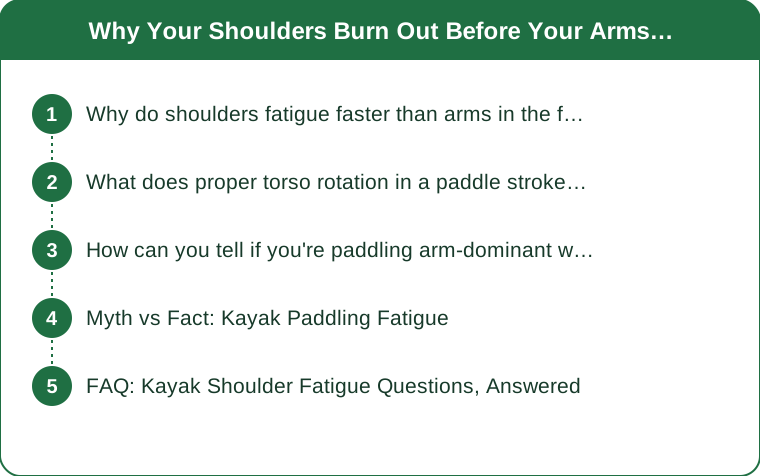
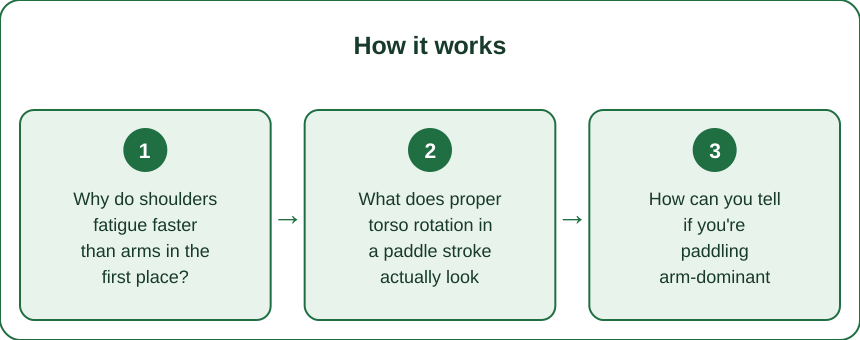
Why do shoulders fatigue faster than arms in the first place?
An arm-dominant paddling stroke relies heavily on the relatively small deltoid and rotator cuff muscles to generate power, which fatigue much faster under repeated load than the larger muscle groups in the torso and back that an efficient stroke should be using instead.
What does proper torso rotation in a paddle stroke actually look like?
Rotating the torso as the paddle enters the water — turning from the core rather than just reaching forward with the arm — engages the obliques, lats, and back muscles to drive the stroke, with the arms functioning more as a connecting lever than the primary power source.

How can you tell if you’re paddling arm-dominant without a coach watching?
If your torso stays relatively still and facing forward throughout the stroke while your arms do most of the visible movement, that’s a strong sign of an arm-dominant technique — proper rotation should visibly turn your shoulders and upper body toward each side with every stroke.
Myth vs Fact: Kayak Paddling Fatigue
Myth: Shoulder fatigue means you need stronger shoulders. Fact: In most cases it means the stroke technique is putting too much load on the shoulders in the first place — fixing rotation reduces the demand rather than requiring more shoulder-specific strength to compensate. Myth: A more expensive paddle fixes fatigue issues. Fact: Paddle quality affects efficiency modestly, but technique has a far larger effect on which muscles bear the workload.
FAQ: Kayak Shoulder Fatigue Questions, Answered
How long does it take to build the habit of rotating the torso properly?
Most paddlers notice the rotation becoming more natural within a few sessions of deliberate practice, though it can take several weeks of consistent attention before it becomes fully automatic.
Does paddle length or blade size affect how much the shoulders are worked?
A paddle that’s too long or has an oversized blade for your strength level can increase shoulder strain regardless of technique, so gear sizing is worth checking alongside a technique review.
Is some shoulder fatigue normal even with good technique?
Some fatigue over a long paddle is expected even with efficient technique, but it should build gradually across a session rather than becoming a limiting factor within the first 15-20 minutes.
TL;DR:
- Arm-dominant strokes overload the relatively small shoulder muscles
- Torso rotation shifts the workload to larger, more fatigue-resistant muscles
- Watching whether your torso rotates is a simple self-check for technique
- A more expensive paddle doesn’t substitute for fixing rotation technique
Early, disproportionate shoulder fatigue is usually a technique signal worth addressing before assuming it’s a conditioning gap.
Keep Reading
This article is for general informational and styling purposes only. Fit, sizing, and product availability may vary.