Why Paddling Into a Headwind Drains You Far More Than the Distance Suggests
Quick Answer: Wind resistance rises steeply with speed, so a headwind increases the force you must overcome disproportionately. On top of that, you spend more time covering the same distance, your paddle catches wind on every recovery stroke, and constant corrective strokes to hold your line add work that does not move you forward. The combination means a headwind leg can cost several times what the same distance costs with the wind behind.
You planned a six-kilometre return trip. The way out took 40 minutes and felt fine. The way back has taken 75 minutes so far and your shoulders are finished.
Why is a headwind so disproportionately hard?
Four separate effects stacking on top of each other.
Aerodynamic drag rises with the square of relative air speed. Doubling the relative wind roughly quadruples the force. Paddling at 5km/h into a 15km/h headwind means a relative air speed of 20km/h against you, rather than 5.
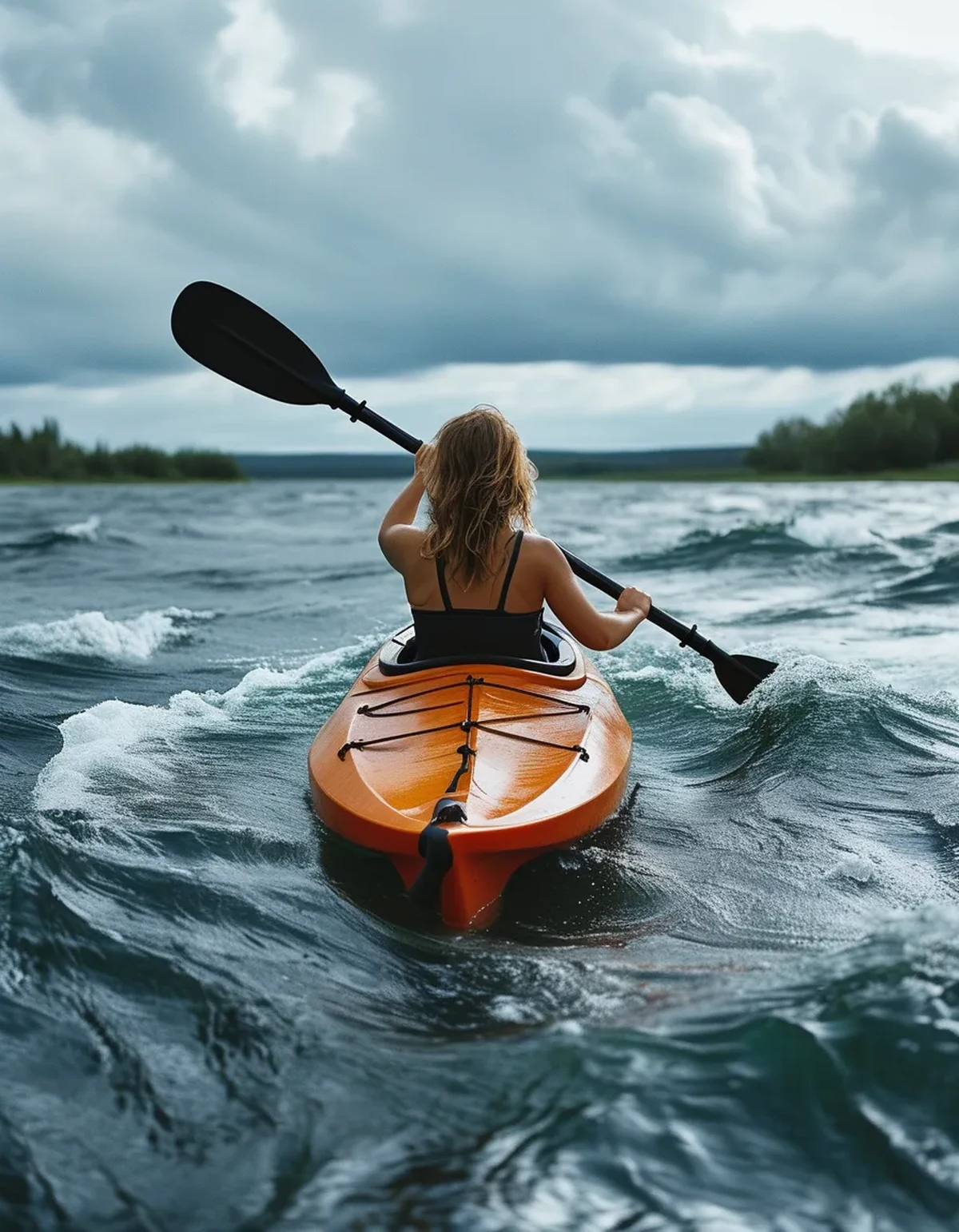
You are exposed. A seated paddler with a raised torso and moving arms presents a substantial frontal area, and a kayak sits high enough at the bow to catch wind too. This is not a low-drag position.
The paddle catches wind on every recovery. The blade returning forward through the air acts as a small sail against you, on every single stroke, hundreds of times an hour. Individually trivial, cumulatively significant.
Time under load increases. If a headwind cuts your speed by a third, you spend half again as long covering the same distance - and you are working harder for every minute of it.
And the fifth factor people forget: wind creates waves and chop, which adds hull resistance and forces constant balance adjustments. Wind is rarely just wind on open water.
Why you drift off course and what it costs
The hidden work that does not appear on any map.
Kayaks tend to turn into the wind - weathercocking. As the boat moves forward, the stern is pushed downwind more than the bow, so the boat swings toward the wind direction. It is a design characteristic rather than a fault.
Correcting it costs energy that produces no forward motion. Every sweep stroke, edge, and rudder correction is work that keeps you pointed the right way rather than moving you along. On a windy day, a meaningful share of your total effort is spent this way.
A skeg or rudder is the direct solution. Deploying a skeg moves the effective pivot point and substantially reduces weathercocking, which is precisely what it exists for. Many paddlers under-use the skeg they already have.
Edging works too. Edging the kayak slightly toward the side you want to turn away from allows the hull shape to help hold your line without corrective strokes.
Loading matters. Weight distribution affects how the boat sits and therefore how it responds to wind. Adding a little weight forward reduces weathercocking in many boats.
And crosswinds are harder than headwinds in this respect, because the corrective work is constant rather than intermittent, even though the forward resistance is lower.

What Nobody Tells You About Wind on the Water
Wind almost always builds through the day on coastal and large inland water. Thermal effects mean mornings are typically calmer, and afternoon is when conditions deteriorate. Planning a return leg for the afternoon into a strengthening wind is the classic trip planning error.
Go out into the wind and come back with it. This is the single most useful piece of planning advice in this article. Doing it the other way means facing the hardest leg when you are already tired, and possibly in worsening conditions.
Wind against tide produces steep, short waves that are far harder than either alone. On tidal water this is a genuine safety consideration and not merely a comfort issue.
A 15-knot headwind is not merely harder than 10 knots, it is disproportionately harder because of the square relationship. Small increases in forecast wind speed make large differences to how a trip feels, which is why paddlers so often say conditions were worse than expected.
Fetch matters as much as wind speed. The distance wind travels over open water determines wave size, so the same wind produces very different conditions on a small lake and a large one.
And the practical safety point: if you are being blown offshore, the situation deteriorates as you tire, and it deteriorates faster than most people anticipate. Turn back earlier than feels necessary when the wind is offshore.
Technique that actually helps into wind
Lower your paddle angle. A high paddle angle exposes more blade to the wind on recovery. Lowering the angle reduces that and lowers your profile slightly, at the cost of some efficiency - a worthwhile trade in strong wind.
Shorten and quicken the stroke. A shorter, higher-cadence stroke maintains momentum better against resistance than long powerful strokes with pauses between them. Losing momentum into wind is expensive to regain.
Keep the recovery blade low and close. Slicing it forward near the deck rather than swinging it high reduces the sail effect meaningfully over hundreds of strokes.
Lower your torso slightly. A small reduction in frontal area helps, and it also lowers your centre of gravity in chop.
Use the skeg or rudder. Reducing corrective strokes is often the single largest efficiency gain available, and many paddlers leave the skeg up out of habit.
Rest in the lee of features. Islands, headlands, and shorelines provide genuine shelter. Planning a route to use them changes the character of a windy day.
Pace it as an endurance effort. Into a headwind, a sustainable rhythm beats hard bursts. Bursts spend energy quickly and the wind takes the momentum back as soon as you stop.
This is general information, not a substitute for formal paddlesports training. Check the forecast, tell someone your plan, wear a buoyancy aid, and take a course in the conditions you intend to paddle in.
FAQ: Paddling in Wind, Answered
Why is paddling into the wind so much harder than paddling with it?
Because air resistance rises with the square of relative air speed, so a headwind adds disproportionate force. Add the extra time under load, the paddle catching wind on every recovery, and constant corrective strokes, and the cost multiplies.
What wind speed is too much for kayaking?
It depends on your skill, the boat, the water, and the fetch. Many recreational paddlers find conditions become challenging above roughly 10-15 knots, particularly with any significant fetch. Local knowledge and formal training matter more than any single number.
Why does my kayak keep turning into the wind?
Weathercocking - the stern is pushed downwind more than the bow as the boat moves forward, swinging the boat toward the wind. Deploying a skeg, edging, or adjusting weight distribution all reduce it.
Should I paddle out into the wind or with it?
Out into the wind, back with it. It means facing the hardest work while fresh and returning with assistance while tired, and it protects you if conditions build through the afternoon, as they typically do.
How do I paddle more efficiently in a headwind?
Lower the paddle angle, shorten and quicken the stroke to maintain momentum, keep the recovery blade low, lower your torso slightly, and use the skeg to cut corrective strokes. Pace it as a steady endurance effort rather than in bursts.
TL;DR:
- Air resistance rises with the square of relative speed, so a headwind adds disproportionate force, not proportionate.
- You also spend longer under load, sail your paddle back on every recovery, and burn energy correcting your line.
- Weathercocking is normal - use the skeg, edge the boat, and stop fighting it with sweep strokes.
- Wind typically builds through the day, so plan the return leg with the wind, not into it.
- Lower paddle angle, shorter quicker strokes, and steady pacing beat power bursts into wind.
The distance was the same in both directions. Everything else about it was not.
Keep Reading
This article is for general informational and styling purposes only. Fit, sizing, and product availability may vary.