Why Your Kayak Feels Heavier at the End of Summer
Quick Answer: Your kayak feels heavier in late summer mostly because of accumulated shoulder and grip fatigue, waterlogged gear, and heat-related drops in perceived exertion tolerance — not because the boat gained weight. A polyethylene hull can absorb a small amount of water through a leaky hatch or scupper, but that is usually 2 to 5 pounds, not the 15 your body is reporting.
The June carry felt fine. Boat up, shoulder in, forty steps to the water, done.
It is late August and that same forty steps now involves a rest stop and some negotiation with yourself in the parking lot.
The boat is the same boat. So what is going on?

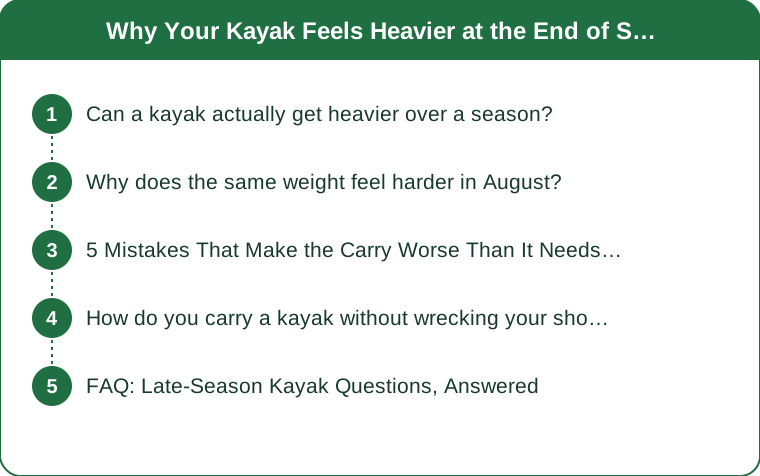
Can a kayak actually get heavier over a season?
A little, yes. Three real sources:
- Water inside the hull. A cracked scupper tube, a hatch cover that stopped sealing, or a hairline crack near a foot brace lets water in slowly. Tip the boat on end after a paddle — if more than a cup drains out, you have a leak worth finding.
- Foam and outfitting. Minicell seat pads and thigh braces absorb water and hold it. Not much, maybe a pound, but it never dries if the boat lives on a rack under a tarp.
- Gear creep. This is the big one. The dry bag, the spare paddle, the anchor, the two water bottles, the seat cushion you added in July. Most people add 8 to 12 pounds of accessories across a season and never subtract any.
Weigh the boat as you actually carry it, fully loaded, on a bathroom scale. The number usually explains half the mystery on its own.
Why does the same weight feel harder in August?
Because you are carrying it with a different body than you had in June.
Grip and shoulder endurance accumulate fatigue across a season if you paddle two or three times a week without any real deload. The forearm flexors that clamp the cockpit rim during a carry are the same ones you have been gripping a paddle shaft with for three months. They are not weaker — they are just not recovered.
Add heat. At 88°F with high humidity, your rate of perceived exertion for identical work climbs noticeably compared to a 70°F morning. Your heart rate is higher before you lift anything, so the carry starts from a worse baseline.
And late-summer dehydration is chronic more than acute. Being down 2 percent body water is enough to make everything feel heavier without ever making you feel thirsty.

5 Mistakes That Make the Carry Worse Than It Needs to Be
- Carrying it fully loaded. Ferry gear separately. Two easy trips beat one grinding one, and the empty boat is 15 to 20 pounds lighter.
- Gripping the cockpit rim. Get your shoulder inside the cockpit and let the coaming rest on the deltoid, then use your hand only for balance. Grip strength should not be the limiting factor.
- Lifting from a bent-over position. Squat to the boat, get it to your thigh, then to your hip, then to the shoulder. Three stages, not one heroic pull.
- Skipping the cart because it is only a short walk. A $40 kayak cart pays for itself the first time you paddle two days in a row.
- Parking far from the water because the close spots were taken. Drop the boat first, then park. Every launch allows this and almost nobody does it.
How do you carry a kayak without wrecking your shoulder?
The shoulder-carry position matters more than strength. Stand at the cockpit, roll the boat onto its side against your legs, reach across and grab the far side of the coaming, then lift and rotate so the near coaming drops onto your shoulder with the hull resting along your back.
Your carrying arm should hang relaxed with the hand on the far coaming for stability. If your shoulder is jammed up near your ear, the boat is too far forward — slide it back until the balance point sits over your shoulder and the bow and stern hang level.
Alternate shoulders. Every single carry. Paddling is already asymmetric enough.
FAQ: Late-Season Kayak Questions, Answered
How do I find a slow leak in a plastic kayak?
Drain and dry the hull, then seal the hatches and press gently on the deck while someone sprays soapy water along the seams, scupper tubes, and around foot brace rivets. Bubbles mark the spot. Most fixes are a new scupper tube or fresh sealant on a rivet.
Should I take a rest week from paddling?
If your grip fails before your shoulders do, yes. Five to seven days off, or paddling half your usual distance, resolves most late-season heaviness. Season-long fatigue is real and it does not fix itself on a two-day weekend.
Does hull material matter for weight over time?
Composite boats stay stable in weight; polyethylene can absorb a small amount of moisture and also deforms in heat, which changes how the boat balances on your shoulder. A hull that sat in the sun on a rack all summer may simply be carrying differently.
TL;DR:
- Real weight gain is usually gear creep plus a small amount of trapped water, not the hull itself
- Accumulated grip and shoulder fatigue across a season is the biggest hidden factor
- Heat and mild chronic dehydration raise perceived exertion before you touch the boat
- Ferry gear separately, use a proper shoulder carry, alternate sides, and take a rest week
Weigh your loaded boat once. Then take a week off paddling and carry it again. If the number is the same and the carry feels easy, it was never the kayak.
Keep Reading
This article is for general informational and styling purposes only. Fit, sizing, and product availability may vary.